

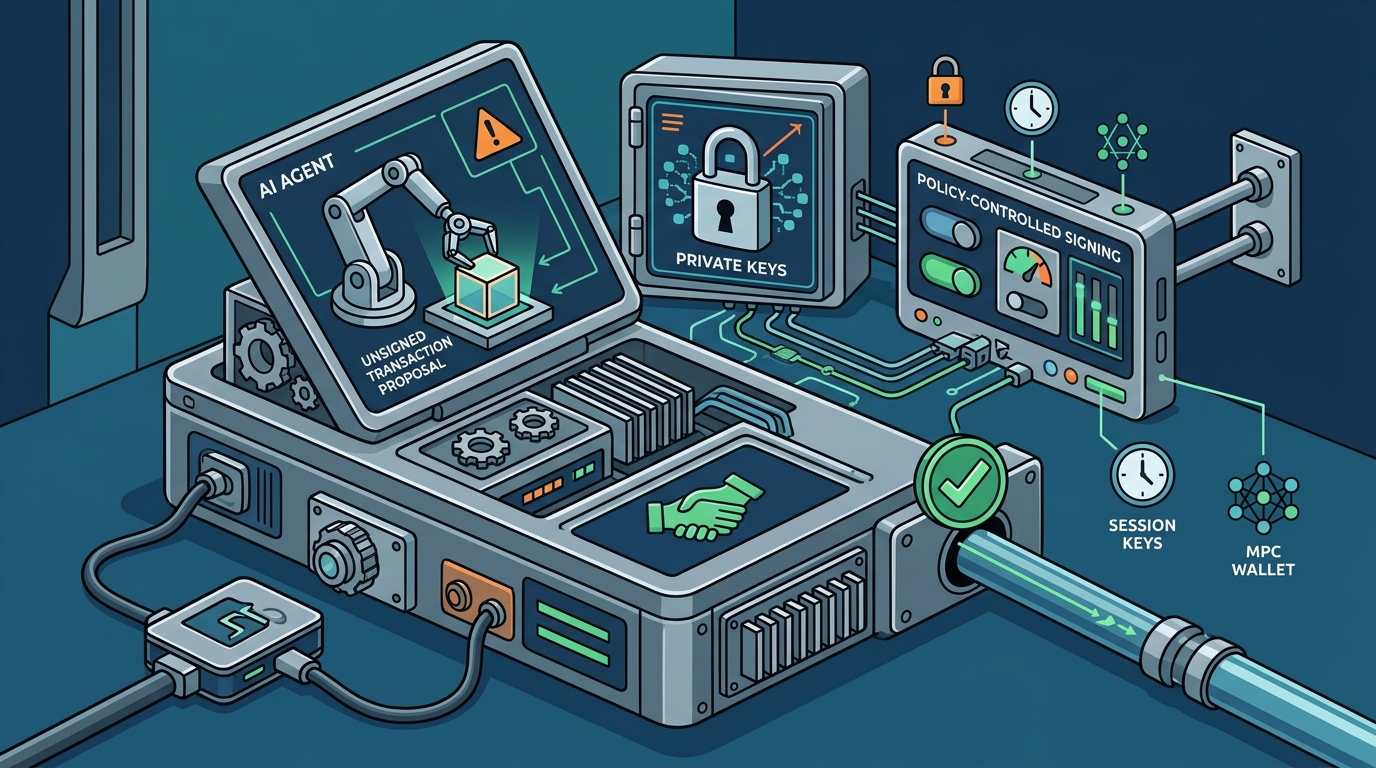
BuildAWallet enables secure AI agent operations by using policy-controlled signing and unsigned transaction proposals. This approach ensures that autonomous agents can construct and propose blockchain transactions without ever accessing or storing private keys. The guide covers eight critical security mechanisms, including hardware wallet integration, session keys, and MPC wallets. It provides a comprehensive framework for developers and users seeking to bridge human financial control with automated agent execution safely. For additional details, review the Your Privacy Choices BuildAWallet.
Policy Controlled Signing
Defining the Policy Boundary
Defining the policy boundary involves specifying exactly what the agent is permitted to do. This includes setting maximum daily spending limits and whitelisting specific network endpoints. For example, a policy might allow an agent to swap tokens on a specific decentralized exchange but prohibit withdrawals to unknown addresses. The granularity of these policies is critical for balancing automation efficiency with security. BuildAWallet's platform is designed to support these complex rule sets, allowing users to tailor the agent's capabilities to their specific risk tolerance. The policy engine evaluates each transaction request in real time, ensuring compliance before the request is passed to the signing stage. For additional details, review the .
Enforcement Mechanisms
Enforcement mechanisms ensure that the policies are strictly applied without exception. This typically involves a deterministic evaluation process that runs on a trusted execution environment. If a transaction fails the policy check, it is rejected immediately, and the agent is notified of the violation. This feedback loop allows the agent to adjust its strategy or request human intervention. The enforcement layer is independent of the agent's code, meaning that the agent cannot modify or bypass the policy rules. This architectural separation is fundamental to the safety of the system. It ensures that the security controls remain intact regardless of the agent's behavior or potential vulnerabilities.
Hardware Wallet Integration
Hardware wallet integration provides a physical layer of security for private keys. By storing keys on a dedicated hardware device, users ensure that the secret material never exists in software memory or on a general-purpose computer. BuildAWallet supports integration with standard hardware wallets, allowing users to sign transactions securely. The agent can interact with the hardware wallet through a secure interface, requesting signatures for proposed transactions. The user then confirms the transaction on the hardware device's screen, providing a final layer of human verification. This approach combines the automation of AI agents with the physical security of hardware devices. It is particularly effective for high-value transactions where additional verification is required.
Secure Communication Channels
Secure communication channels are essential for interacting with hardware wallets. The agent must establish a trusted connection with the device to transmit transaction data. This connection is typically encrypted and authenticated to prevent man-in-the-middle attacks. The hardware device displays the transaction details in a human-readable format, allowing the user to verify the recipient and amount. This visual confirmation is a critical security feature, as it protects against malicious software that might alter transaction data in transit. BuildAWallet's integration ensures that these communication channels are robust and secure, providing a reliable link between the agent and the hardware device.
User Verification Steps
User verification steps involve the physical interaction with the hardware wallet. The user must physically press a button on the device to approve the transaction. This action confirms that a human is present and has reviewed the transaction details. For high-risk operations, additional verification steps may be required, such as entering a PIN code. These steps ensure that the transaction is authorized by the legitimate owner of the funds. The hardware wallet integration in BuildAWallet is designed to streamline this process while maintaining strict security standards. It allows users to benefit from automation without compromising their control over their assets.
Unsigned Transaction Proposal
Unsigned transaction proposal is a workflow where the agent constructs a transaction but does not sign it. Instead, the agent submits the unsigned transaction to a human user or a policy engine for review and approval. This method ensures that the agent never has access to the private key required for signing. The user can inspect the transaction details, including the recipient, amount, and gas fees, before deciding whether to sign it. This approach provides a high level of transparency and control. It allows users to maintain full custody of their keys while still benefiting from the agent's ability to identify and prepare transactions. BuildAWallet supports this workflow, enabling users to review and approve agent-generated transactions with confidence.
Transaction Inspection
Transaction inspection involves reviewing the details of the unsigned transaction. The user can decode the transaction data to understand the specific actions being performed. This includes checking the smart contract address, function selector, and input parameters. By inspecting the transaction, the user can verify that the agent is performing the intended operation. This step is crucial for preventing malicious transactions that might appear legitimate on the surface. BuildAWallet provides tools to facilitate this inspection, making it easy for users to understand complex transaction data. The goal is to empower users with the knowledge they need to make informed decisions about their transactions.
Approval Workflow
The approval workflow defines the process for signing the unsigned transaction. Once the user has reviewed and approved the transaction, they can sign it using their preferred method, such as a hardware wallet or a software wallet. The signed transaction is then broadcast to the network. This workflow ensures that the signing process is controlled by the user, not the agent. It provides a clear separation of duties, with the agent responsible for transaction construction and the user responsible for transaction approval. BuildAWallet's platform is designed to support this workflow seamlessly, providing a user-friendly interface for reviewing and approving transactions.
Unsigned Transaction Construction
Unsigned transaction construction is the process of creating a valid blockchain transaction without a digital signature. The agent gathers the necessary data, such as the recipient address, amount, and nonce, and assembles it into a transaction object. This object is then encoded in a format that can be signed by a private key. The construction process must be precise to ensure that the transaction is valid and will be accepted by the network. BuildAWallet's agent infrastructure is designed to handle this construction process efficiently, ensuring that the resulting transaction is ready for signing. This step is critical for the overall workflow, as it determines the quality and validity of the proposed transaction.
Data Validation
Data validation is a key part of transaction construction. The agent must verify that all input data is correct and within expected ranges. This includes checking that the recipient address is valid and that the amount is sufficient to cover the transaction fees. Validation errors can cause the transaction to fail, resulting in wasted gas fees. BuildAWallet's platform includes robust validation logic to prevent these errors. It ensures that the transaction data is accurate and complete before it is passed to the signing stage. This reduces the risk of failed transactions and improves the overall reliability of the system.
Encoding Standards
Encoding standards define how the transaction data is formatted for signing. Different blockchain networks use different encoding formats, such as RLP for Ethereum or MessagePack for Solana. The agent must encode the transaction data in the correct format for the target network. This ensures that the transaction can be properly signed and broadcast. BuildAWallet supports multiple encoding standards, allowing agents to construct transactions for various networks. The platform handles the encoding process automatically, reducing the complexity for developers and ensuring compatibility with different blockchain ecosystems.
Session Keys
Session keys are temporary cryptographic keys that are generated for a specific session or task. Unlike long-term private keys, session keys have a limited lifespan and are discarded after use. This approach reduces the risk of key compromise, as the key is only valid for a short period. BuildAWallet can use session keys to allow agents to sign transactions without accessing the user's primary private key. The session key is derived from the primary key using a secure key derivation function. This ensures that the session key is cryptographically linked to the primary key but does not reveal it. The use of session keys provides a balance between security and convenience, allowing agents to operate autonomously while minimizing the risk of key exposure.
Key Derivation
Key derivation is the process of generating a session key from a primary key. This process uses a cryptographic algorithm to ensure that the session key is secure and unpredictable. The derivation process is deterministic, meaning that the same session key can be regenerated if needed. This allows for flexible key management, where session keys can be created and destroyed as required. BuildAWallet's platform supports secure key derivation, ensuring that session keys are generated in a safe and efficient manner. The use of key derivation enhances the security of the system by limiting the exposure of the primary key.
Lifecycle Management
Lifecycle management involves controlling the creation, use, and destruction of session keys. The session key is created when a new session begins and is destroyed when the session ends. This ensures that the key is not left active for longer than necessary. The lifecycle management process also includes monitoring the use of the session key to detect any suspicious activity. BuildAWallet's platform provides tools for managing the lifecycle of session keys, ensuring that they are used securely and efficiently. This approach helps to maintain the integrity of the system and protect user funds from potential threats.
Smart Account Policies
Multi-Signature Requirements
Time-Lock Mechanisms
Hardware Wallet Signing
Hardware wallet signing is the process of using a hardware device to sign a transaction. This method ensures that the private key never leaves the secure hardware environment. The user interacts with the hardware wallet to approve the transaction, providing a physical confirmation of their intent. BuildAWallet supports hardware wallet signing, allowing users to sign transactions securely. This approach is ideal for users who want to maintain full control over their keys while still benefiting from automation. The hardware wallet signing process is straightforward and user-friendly, making it accessible to a wide range of users.
Device Compatibility
Security Features
MPC Wallets
Key Share Distribution
Key share distribution involves splitting the private key into multiple shares and distributing them to different parties. Each share is stored securely, and no single party has access to the complete key. BuildAWallet's platform supports key share distribution, allowing users to define the number of shares and the threshold required for signing. This ensures that the key is protected from compromise, as an attacker would need to obtain multiple shares to sign a transaction. The distribution of key shares enhances the security of the wallet and provides a robust solution for key management.
Threshold Signatures
Threshold signatures require a minimum number of key shares to sign a transaction. This threshold is defined by the user and can be adjusted based on security requirements. BuildAWallet's MPC wallets support threshold signatures, allowing users to set the required number of shares for signing. This provides flexibility in key management, as users can define the level of security that is appropriate for their needs. The use of threshold signatures ensures that the wallet is secure while still allowing for efficient transaction signing.
Key Takeaways
- Policy controlled signing allows agents to propose transactions that are evaluated against predefined rules before signing.
- Hardware wallet integration provides a physical layer of security by storing keys on a dedicated device.
- Unsigned transaction proposal ensures that agents never have access to the private key, requiring human approval for signing.
- Unsigned transaction construction involves creating a valid transaction object without a digital signature.
- Session keys are temporary keys that reduce the risk of key compromise by having a limited lifespan.
- Smart account policies embed rules within a smart contract to govern transaction execution.
- Hardware wallet signing uses a physical device to sign transactions, ensuring the key never leaves the secure environment.
- MPC wallets split the private key into multiple shares, eliminating a single point of failure.
Frequently Asked Questions
What is policy controlled signing?
Policy controlled signing is a security mechanism where transaction approval is governed by predefined rules rather than direct key access.
How does hardware wallet integration work?
Hardware wallet integration allows users to sign transactions using a dedicated hardware device, ensuring the private key never leaves the secure environment.
What is an unsigned transaction proposal?
An unsigned transaction proposal is a workflow where the agent constructs a transaction but does not sign it, requiring human approval for signing.
How are session keys generated?
Session keys are generated from a primary key using a secure key derivation function, ensuring they are cryptographically linked but do not reveal the primary key.
What are smart account policies?
Smart account policies are rules defined within a smart contract that govern how transactions are executed, including multi-signature requirements and time-locks.
How do MPC wallets work?
MPC wallets split a private key into multiple shares, requiring multiple shares to be combined to produce a valid signature, eliminating a single point of failure.
Conclusion
Securing AI agent crypto transactions without exposing private keys is achievable through a combination of policy controls, hardware integration, and advanced cryptographic techniques. BuildAWallet provides a comprehensive platform that supports these methods, allowing users to maintain full control over their funds while benefiting from automation. By leveraging policy controlled signing, hardware wallet integration, and MPC wallets, users can create a robust security framework that protects their assets from potential threats. The platform's focus on user control and policy-controlled signing positions it as a leading solution for secure agent operations. To explore how BuildAWallet can secure your agent workflows, visit the BuildAWallet homepage.