

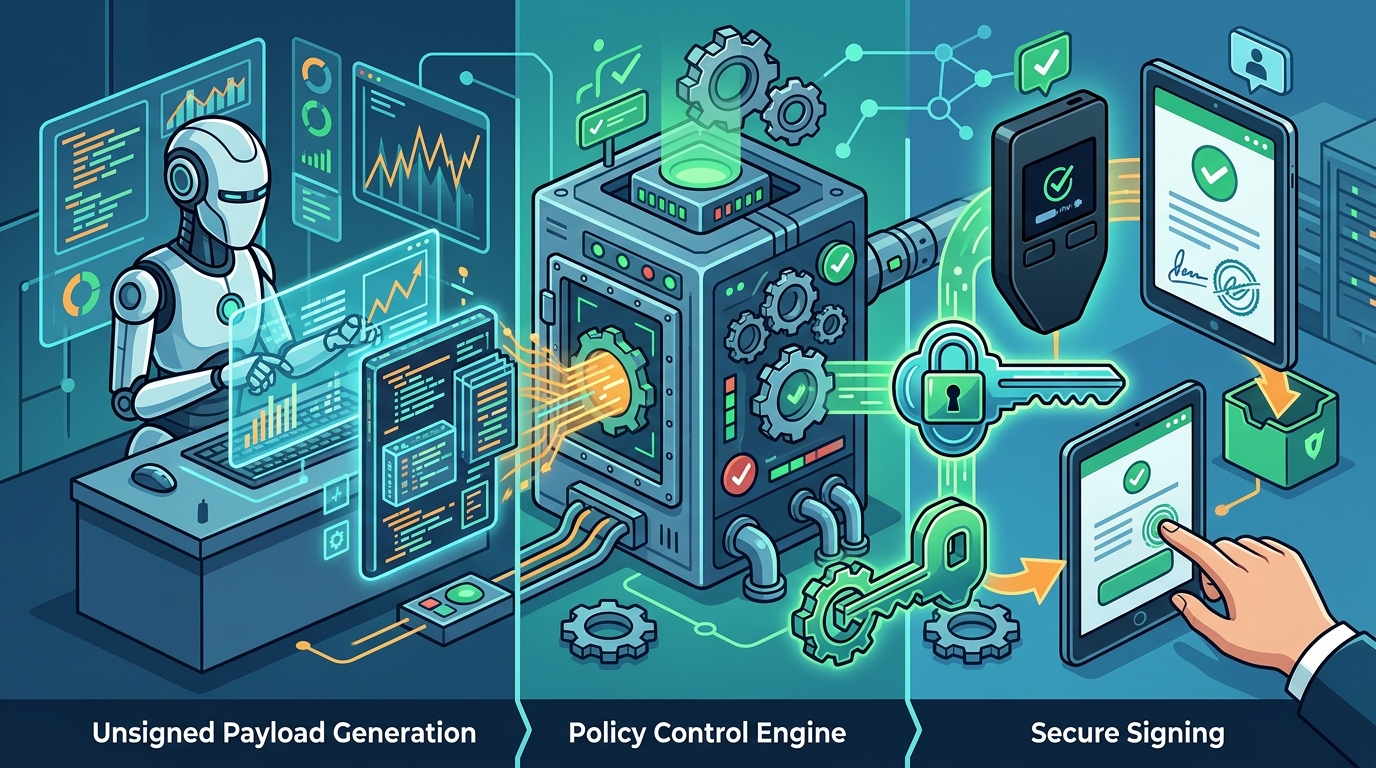
Use a policy-controlled wallet interface that separates transaction creation from cryptographic signing. This architecture ensures your trading bot generates unsigned payloads while your hardware device or human interface executes the final signature. This guide covers the technical implementation of signature delegation, policy engines, and secure key management for autonomous agents. For additional details, review the BuildAWallet Human or machine.
WalletConnect Signature Requests
WalletConnect is a protocol that enables peer-to-peer communication between dApps and wallets. It allows a decentralized application to request a signature from a user's wallet without exposing private keys to the application. For trading bots, this protocol serves as a bridge between the automated logic and the human approval layer. For additional details, review the .
How the Handshake Works
The process begins when the bot initiates a pairing request. The user scans a QR code or approves the connection via their mobile device. Once paired, the bot can send transaction requests. The user reviews the details on their device and signs the transaction locally. This ensures the private key never leaves the user's control. For additional details, review the Customer Experience.
Limitations for High-Frequency Trading
While secure, manual approval for every transaction is impractical for high-frequency strategies. Users must approve each trade individually. This creates a bottleneck for bots executing multiple trades per minute. Advanced setups require automation of the approval process while maintaining security.
Policy Controlled Signing
Policy controlled signing is a security mechanism that defines rules for when a transaction can be signed. It acts as a gatekeeper between the bot's logic and the signing key. This approach allows for automated execution within strict boundaries.
Defining the Rules
Implementation in BuildAWallet
BuildAWallet provides infrastructure for policy-controlled signing. The platform allows users to define these rules within the wallet configuration. The bot interacts with the wallet API, which enforces the policies. This ensures that even if the bot is compromised, the damage is limited by the predefined rules. The system returns unsigned transactions for policy validation, ensuring the key remains secure.
Hardware Wallet Integration
Hardware wallet integration is the process of connecting a physical security device to a software interface. It provides an air-gapped environment for key storage. This is the gold standard for securing significant assets.
Connecting to Bots
Security Benefits
Using a hardware wallet ensures that the private key never exists in the bot's memory. Even if the server is hacked, the attacker cannot extract the key. The physical device must be present and approved for each transaction. This adds a layer of physical security to the digital workflow.
Session Keys
A session key is a temporary cryptographic key derived from a master key. It allows a bot to sign transactions without accessing the master private key. This is a common pattern in institutional trading infrastructure.
Derivation and Scope
Session keys are derived using hierarchical deterministic (HD) wallets. The master key generates a tree of child keys. Each session key can be scoped to specific chains or contracts. This limits the exposure of the master key. If a session key is compromised, the master key remains safe.
Revocation and Rotation
Session keys can be revoked by the master key holder. This is crucial for security incident response. Regular rotation of session keys is also recommended. This ensures that long-term exposure is minimized. BuildAWallet supports the management of these keys through its non-custodial architecture.
Hardware Wallet Signing
Hardware wallet signing is the cryptographic process of approving a transaction on a physical device. It involves the user physically confirming the transaction details on the device screen. This final step ensures human oversight of automated actions.
The Signing Workflow
The bot creates an unsigned transaction and sends it to the signing interface. The interface forwards the data to the hardware wallet. The user reviews the transaction details, including the recipient and amount. If the details match the policy, the user approves the signature. The hardware wallet signs the transaction and returns the signature to the bot.
Best Practices
Always verify the transaction details on the hardware wallet screen. Do not rely solely on the bot's display. Use a trusted hardware wallet from a reputable manufacturer. Keep the firmware updated to protect against known vulnerabilities. This combination of software policies and hardware security provides the highest level of protection.
Comparison of Signature Control Methods
| Method | Security Level | Automation Capability | Best For |
|---|---|---|---|
| WalletConnect | High | Low (Manual Approval) | Low-frequency trading |
| Policy Controlled | High | Medium (Rule-based) | Medium-frequency trading |
| Session Keys | Medium | High (Full Automation) | High-frequency trading |
| Hardware Wallet | Maximum | Low (Physical Approval) | Large asset protection |
Key Takeaways
- Separate transaction creation from cryptographic signing to protect private keys.
- Use policy controlled signing to define boundaries for automated trading.
- Hardware wallets provide the highest security but require manual approval.
- Session keys allow for high-frequency trading with limited exposure.
- WalletConnect is suitable for low-frequency strategies requiring human oversight.
- Regular key rotation and policy updates are essential for long-term security.
- Always verify transaction details on the hardware device screen.
Frequently Asked Questions
Can a trading bot hold my private key?
No, a trading bot should never hold your master private key. It should only have access to unsigned transactions or scoped session keys. This ensures that even if the bot is compromised, your main assets remain secure.
What is the difference between a session key and a master key?
A master key is the root key that controls all assets. A session key is a temporary key derived from the master key. Session keys can be scoped and revoked, limiting their impact if compromised.
How does policy controlled signing work?
Is WalletConnect secure for trading bots?
WalletConnect is secure for low-frequency trading. It requires manual approval for each transaction. For high-frequency trading, it may be too slow and impractical.
Can I use a hardware wallet with a trading bot?
Yes, but it requires a middleware layer. The bot sends unsigned transactions to the middleware, which forwards them to the hardware wallet. The user must approve each transaction on the device.
What is the best tool for high-frequency trading?
Session keys are the best tool for high-frequency trading. They allow for full automation while limiting exposure. Combine them with policy controlled signing for added security.
How do I revoke a session key?
You can revoke a session key using the master key. This invalidates the session key, preventing it from signing further transactions. This is a critical security feature.
Does BuildAWallet support policy controlled signing?
Yes, BuildAWallet provides infrastructure for policy controlled signing. The platform allows users to define rules and enforce them through its non-custodial architecture.
Conclusion
Securing your trading bot requires a layered approach to signature control. By separating transaction creation from signing, you protect your private keys. Use policy controlled signing to define boundaries and hardware wallets for maximum security. BuildAWallet provides the infrastructure to implement these controls effectively. Explore the human wallet setup to configure your policy engine. For agent-specific needs, visit the machine interface to integrate paid APIs. Start by defining your risk tolerance and trading frequency. Choose the signature control method that matches your needs. Implement the controls and test thoroughly before going live. Regularly review your policies and rotate keys. This approach ensures that your trading bot operates securely and efficiently.