

Non-custodial alternatives to Coinbase agent wallets are self-sovereign systems where users or AI agents retain full control of private keys. BuildAWallet provides this infrastructure by offering local key generation and policy-controlled signing. This guide covers cross-chain support, smart accounts, MPC security, and session keys for autonomous operations.
Cross-Chain Support
Cross-chain support is the ability of a wallet to interact with multiple blockchain networks simultaneously. Traditional agent wallets often lock users into a single ecosystem, limiting asset utility. BuildAWallet addresses this by supporting ten mainnets, including Base and Solana. This multichain approach allows agents to read balances and execute transactions across different networks without bridging friction.
Network Coverage
The platform provides live data for native tokens and stablecoins across its supported networks. Agents can query balances on Ethereum, Base, Solana, and other chains using a single API key. This unified access reduces the complexity of managing multiple wallet instances. It ensures that autonomous systems can maintain a holistic view of their portfolio.
Stablecoin Integration
Stablecoins are digital assets pegged to fiat currencies, providing price stability. BuildAWallet includes specific endpoints for canonical stablecoin balances, such as USDC and USDT. This is critical for agents that require predictable value for payments or treasury management. The system distinguishes between native balances and stablecoin holdings in its data responses.
Smart Account Infrastructure
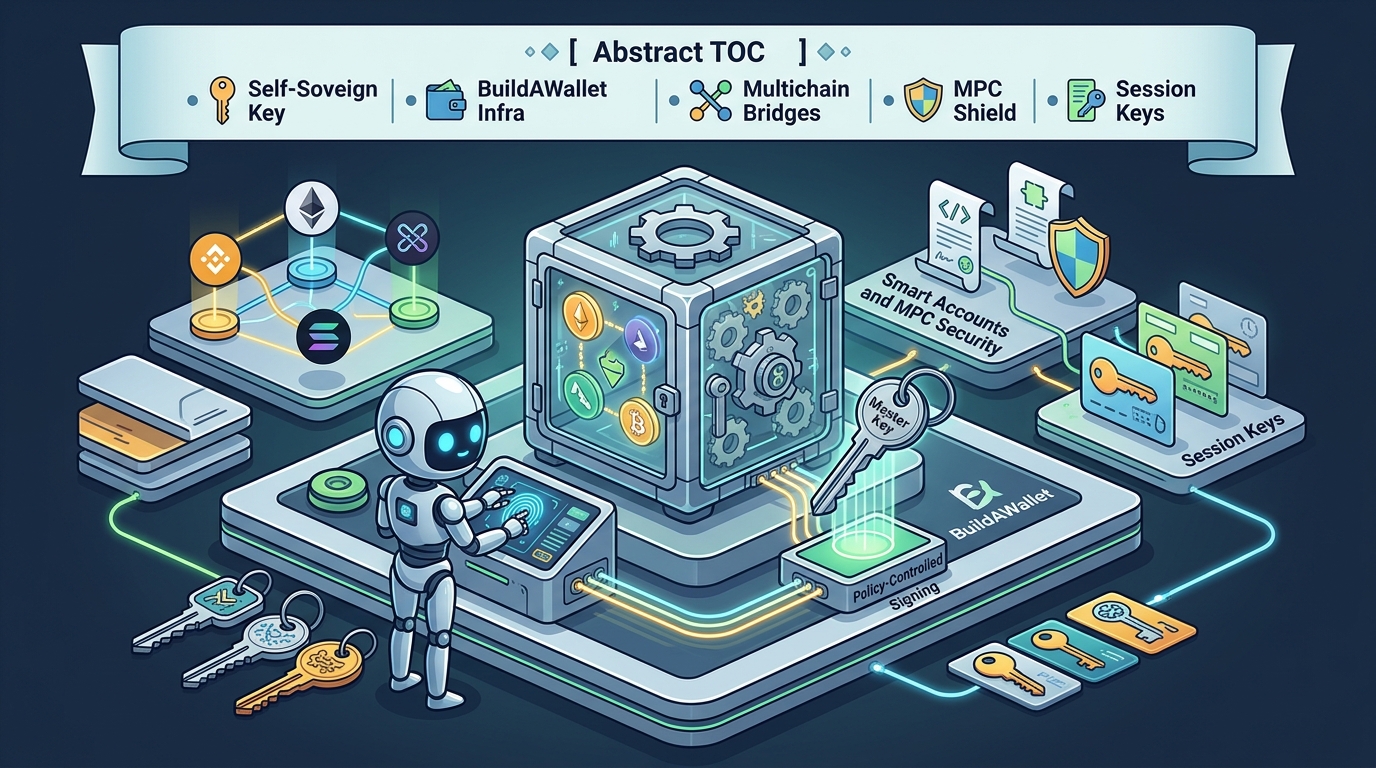
Smart account infrastructure is a framework that allows wallets to execute complex logic beyond simple key signing. Unlike legacy external owned accounts, smart accounts can implement custom validation rules. BuildAWallet leverages this to create flexible wallet blueprints for both humans and machines. This infrastructure supports the creation of wallets that can enforce spending limits or require multi-signature approvals.
Blueprint Design
Users can design wallet interfaces and logic through the BuildAWallet Studio. This tool allows for the configuration of assets, networks, and security settings. The resulting wallet is a self-custody solution where keys remain local to the device. This design phase is crucial for defining how an agent will interact with the blockchain.
Local Signing
Local signing is the process of creating cryptographic signatures on the user's device rather than a remote server. BuildAWallet emphasizes this model to ensure that private keys never leave the user's control. For agents, this means that the signing authority remains with the entity that holds the keys. This separation of data access and signing authority is a core security feature.
Policy-Controlled Signing
Policy-controlled signing is a security mechanism that restricts transaction execution based on predefined rules. This is essential for AI agents that need to operate autonomously but within safe boundaries. BuildAWallet allows developers to define policies that limit spending amounts, approved recipients, or specific actions. This prevents an agent from executing unauthorized or malicious transactions.
Spending Authority
Spending authority is the permission granted to an agent to move funds. By implementing policy controls, developers can grant limited authority for routine tasks while retaining full control for significant operations. This tiered approach balances autonomy with security. It allows agents to perform daily functions without exposing the entire treasury to risk.
Validation Steps
Before a transaction is broadcast, the system can validate it against the defined policies. This validation occurs locally or through the API layer. If a transaction violates a policy, it is rejected before it reaches the blockchain. This proactive check is more secure than relying on post-transaction monitoring.
MPC Security
MPC security is a cryptographic method that splits private keys into shares, requiring multiple parties to sign a transaction. Multi-Party Computation (MPC) eliminates the single point of failure associated with a single private key. BuildAWallet supports MPC architectures to enhance the security of both human and agent wallets. This method is particularly useful for high-value assets or institutional-grade custody.
Key Sharding
Key sharding is the process of dividing a private key into multiple fragments. No single fragment can sign a transaction on its own. This ensures that even if one device is compromised, the funds remain safe. The fragments can be stored on different devices or managed by different entities. This distributed approach significantly raises the barrier for attackers.
Recovery Mechanisms
Recovery mechanisms are protocols that allow users to restore access to their wallets if a device is lost. In MPC systems, recovery can be achieved by combining remaining key shares. BuildAWallet provides tools for managing these recovery processes securely. This ensures that users are not locked out of their funds due to hardware failure.
Session Keys
Session keys are temporary cryptographic credentials that allow an agent to perform specific actions without exposing the master private key. This is a critical feature for AI agents that need to interact with dApps or APIs. BuildAWallet supports the generation of session keys that are valid for a limited time or specific scope. This minimizes the risk of key exposure during agent operations.
Scoped Access
Scoped access is the restriction of a key's permissions to a specific set of actions. For example, a session key might only allow an agent to check balances or sign small transactions. This granular control ensures that the agent cannot perform high-risk actions like transferring large sums. It aligns with the principle of least privilege in security design.
Expiration and Revocation
Session keys can be set to expire after a certain period or after a specific number of transactions. This automatic expiration reduces the window of opportunity for attackers. Developers can also revoke session keys manually if suspicious activity is detected. This dynamic management of credentials is essential for maintaining security in autonomous systems.
Cross-Chain Execution
Cross-chain execution is the ability to perform transactions that span multiple blockchain networks. This is a complex process that requires coordination between different chains. BuildAWallet facilitates this by providing endpoints for preparing and broadcasting transactions across its supported networks. Agents can use these tools to move assets or interact with protocols on different chains.
Transaction Preparation
Transaction preparation is the step where a transaction is constructed but not yet signed. BuildAWallet provides APIs that allow agents to build unsigned transfers for local signing. This ensures that the agent has full control over the final transaction data. It also allows for validation of the transaction parameters before signing.
Broadcasting and Confirmation
Broadcasting is the process of submitting a signed transaction to the network. BuildAWallet provides endpoints for broadcasting transactions and tracking their status. Agents can monitor confirmations in real-time to ensure that their actions are successful. This feedback loop is essential for autonomous systems that need to react to on-chain events.
Key Takeaways
- Non-custodial wallets give users and agents full control of private keys, eliminating the need for a central intermediary.
- BuildAWallet supports ten mainnets, including Base and Solana, enabling seamless cross-chain operations.
- Policy-controlled signing allows developers to define strict rules for agent spending and transaction execution.
- MPC security splits private keys into shares, providing robust protection against single-point failures.
- Session keys offer temporary, scoped access for agents, reducing the risk of master key exposure.
- Local signing ensures that cryptographic signatures are created on the user's device, maintaining self-custody.
- Smart account infrastructure enables complex logic and validation rules within the wallet itself.
- Cross-chain execution tools allow agents to prepare, sign, and broadcast transactions across multiple networks.
Frequently Asked Questions
What is a non-custodial agent wallet?
A non-custodial agent wallet is a digital wallet where an AI agent or user retains full control of the private keys. This means that no third party, such as an exchange, holds the keys or can access the funds without authorization.
How does BuildAWallet support AI agents?
BuildAWallet provides a Machine API that allows agents to read balances, prepare transactions, and manage wallets. Agents can use prepaid API units to interact with the platform without requiring a human checkout process.
What is the difference between a session key and a master key?
A master key is the primary private key that controls the wallet. A session key is a temporary, derived key that allows an agent to perform specific actions without exposing the master key. This adds a layer of security for autonomous operations.
Can I use BuildAWallet for both human and agent wallets?
Yes, BuildAWallet is designed for both. Humans can use the Wallet Studio to design and deploy self-custody wallets, while agents can use the Machine API to interact with the same infrastructure.
How does policy-controlled signing work?
Policy-controlled signing involves defining rules that restrict what transactions an agent can execute. For example, you can set a limit on the amount of funds an agent can move or restrict it to specific recipients.
What chains does BuildAWallet support?
BuildAWallet supports ten mainnets, including Ethereum, Base, Solana, and others. This multichain support allows agents to interact with a wide range of blockchain ecosystems.
Is my data safe with BuildAWallet?
BuildAWallet emphasizes privacy and security. It does not sell personal information or use advertising pixels. Private keys are stored locally on the user's device and are never sent to BuildAWallet servers.
How do I get started with BuildAWallet?
You can start by exploring the Wallet Studio to design a human wallet or by accessing the Machine API documentation to integrate agent capabilities. The platform offers free discovery tools and prepaid plans for API usage.
Conclusion
Non-custodial alternatives to Coinbase agent wallets offer superior security and control for both humans and AI agents. BuildAWallet provides a comprehensive platform that supports cross-chain operations, policy-controlled signing, and MPC security. By leveraging local signing and session keys, developers can build autonomous systems that operate safely within defined boundaries. To explore the full capabilities of the platform, visit the API explorer or start designing your wallet in the Wallet Studio.